
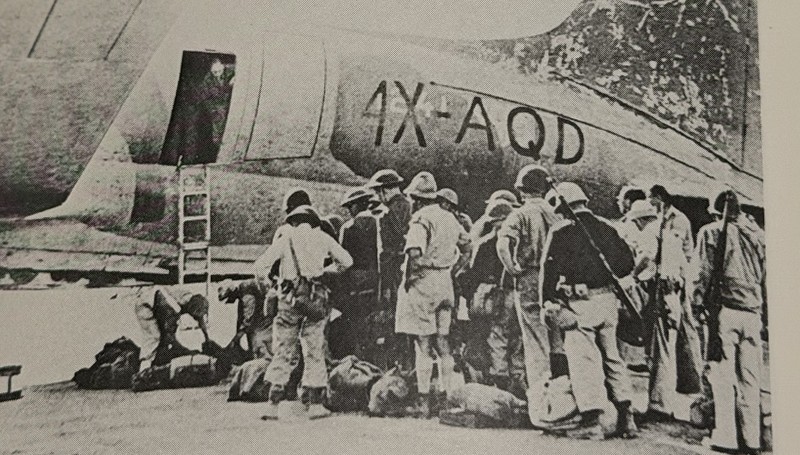
In the spring of 1948 the new State of Israel faced five Arab armies that were already equipped as sovereign nations, with arsenals of modern weapons and reserves to spare. Israel had almost nothing. The United States had imposed an arms embargo on every combatant in Palestine, and Britain had no intention of helping the emerging Jewish state. For a country about to be invaded, the embargo was close to a death sentence. The answer that kept Israel supplied through that first summer was an improvised, mostly volunteer airline known as the Air Transport Command, the ATC.
The embargo problem
The Haganah’s arms-procurement branch, Rekhesh, scoured the world for weapons left over from the Second World War, from North and South America to Europe and the Libyan Desert. Finding guns was one task. Getting them to Israel while the embargo held was another. Of the very few countries willing to sell, Czechoslovakia stood out. Desperate for hard currency, and with Moscow’s quiet approval, it agreed to supply rifles, machine guns, ammunition, and the fighter aircraft Israel had no other way to obtain. Yugoslavia opened its ports and airfields for transshipment. The remaining question was how to carry it all the length of the Mediterranean, fast, past governments that were trying to stop exactly that.
Al Schwimmer and the secret airline
The plan came from Adolph “Al” Schwimmer, a thirty-year-old former U.S. Army Air Force man who had flown more than 280 Atlantic crossings as a flight engineer for TWA. Approached by the Haganah’s Yehuda Arazi in New York in the autumn of 1947, Schwimmer argued that with proper financing he could assemble an airline, break the embargo, and fly the arms in himself.
He bought what he needed from the glut of war-surplus aircraft on the American market: C-46 Curtiss Commando transports and three Lockheed C-69 Constellations, the long-range four-engine aircraft that could make the ocean crossing. To hide the planes and their purpose from the U.S. government and the FBI, the operation acquired a dormant New York charter outfit called Service Airways, run by ex-Army pilot Irvin “Swifty” Schindler. Schwimmer’s chief pilot was Sam Lewis, a TWA flyer he had known from their days in the wartime U.S. Army Air Transport Command, the namesake of the volunteer command they were about to build.
Recruiting the crews
The aircrews came from a careful, quiet canvass of Second World War veterans. Someone connected to Service Airways obtained Air National Guard and air-force rosters, and recruiters placed carefully worded telephone calls to men with Jewish-sounding names. Those who had flown bombers or transports, were Jewish, and answered the guarded questions correctly received a short letter asking a simple thing: how would you like to fly munitions and refugees into Palestine? The pay for waiting in New York was twenty-five dollars a month, a seven-dollar daily food allowance, and a cheap hotel room. Whatever drew these men, it was plainly not the money.
Flags of convenience: LAPSA
American law and the FBI made it impossible to run the operation openly from the United States. The Civil Aeronautics Authority refused to certify Schwimmer’s modified aircraft, and the Bureau of Customs began investigating the fleet parked at Millville, New Jersey. The solution was a flag of convenience. Working through Panamanian contacts, the group persuaded Panama, eager for the prestige of a national airline, to grant Service Airways a franchise. Líneas Aéreas de Panamá, Sociedad Anónima, known as LAPSA, was born in February 1948. Once the aircraft were leased to LAPSA they carried Panamanian registration and fell outside CAA rules, and their fuselages wore the LAPSA banner over the real purpose underneath.
On May 6, 1948, five LAPSA C-46s took off from Panama on a flight plan that called the trip a “route survey flight” to Natal in eastern Brazil. Natal was the closest point in South America to Europe and Africa, and the crews had no intention of returning. They pressed on toward Sicily and, ultimately, Czechoslovakia and Israel.
Zatec and Operation Balak
The European hub became Zatec airfield in Czechoslovakia, a town once known for brewing that had built Messerschmitt 109 fighters during the war. In 1948 it turned into the loading point for the airlift that carried war materiel, including the disassembled Messerschmitts, to Israel. Ground crews lived at Zatec, and a Machal pilot set up a training facility there. From there the route ran to Israel, refueling where sympathetic governments would allow it. When Britain and the United States pressured Italy into revoking LAPSA’s landing rights, France let the flights stop at Ajaccio in Corsica, a reflection of a postwar French parliament still shaped by its anti-Nazi resistance.
The airlift from Czechoslovakia, code-named Operation Balak, began on May 20, 1948. By June 11 two Constellations alone had made thirty flights and delivered more than a hundred tons of cargo. This was the true beginning of the Air Transport Command, flown mainly by North American Machal volunteers: former U.S. Army Air Force and Canadian bomber pilots, navigators, and radio operators.
What the ATC delivered
The command’s primary job was long-range supply, ferrying in the heavy weapons and fighter aircraft that Israel could get no other way. Between those missions, ATC aircrews were drafted for bombing and troop-transport operations, so the command flew combat as well. The cost was real. Air Force personnel died in crashes caused by the substandard condition of the surplus equipment and, at times, by too little transition training on the aircraft they were handed.
The strategic payoff is easiest to see in the Messerschmitts. When an Egyptian column drove north toward Tel Aviv and reached Ashdod, Israel’s first Messerschmitts, newly assembled from parts the airlift had carried in, were thrown into the fight. The aircraft did limited physical damage, yet their appearance shocked the Egyptian command. No one had imagined Israel possessed fighter planes, and the advance toward the heart of the country lost its momentum. Those aircraft reached the battlefield because the ATC flew them in.
From airlift to bombing campaign
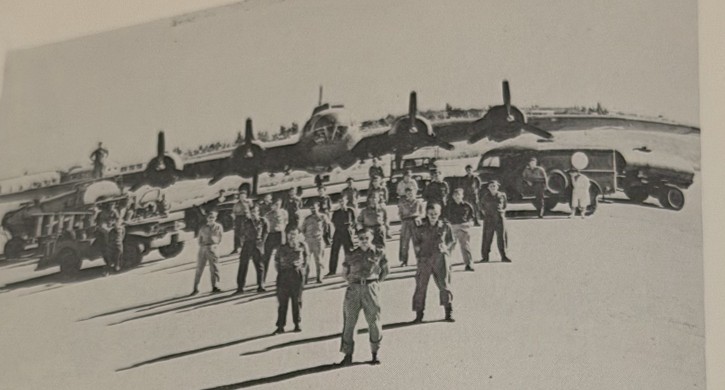
The command’s reach into combat went further than resupply. The same aircraft, bases, and aircrews that flew the Zatec lifeline carried out Israel’s first strategic bombing of Arab capitals. The link ran through three B-17 Flying Fortresses, former U.S. Army heavy bombers that the operation smuggled out of the United States, flew to Zatec, and refitted there with bomb racks and rudimentary bombsights. The crews chosen to bring them into Israel were drawn mostly from the Air Transport Command.
On July 15, 1948, rather than ferry the bombers in empty, the air force ordered them to strike on the way. The lead B-17, fitted with a German bombsight and flown by Bill Katz with Ray Kurtz as mission commander and co-pilot, bombed Cairo at sunset while its bombardier aimed for King Farouk’s palace. The other two, flown by Norman Moonitz and Al Raisen, struck Gaza and Rafah. Those three aircraft then formed the heavy-bomber core of 69 Squadron, commanded by Katz, and flew repeated raids on El Arish, Majdal, and the trapped Egyptian force at Faluja through the autumn, becoming, in one Egyptian officer’s diary, “a regular feature every day.”
Syria was hit on the eve of the first truce. A Dakota lifted off from Ekron at 2:10 a.m., flown by Cyril Katz with Leslie Chimes beside him and Smoky Simon navigating, and made six passes over a brightly lit Damascus, dropping 2,400 kilos of bombs and three boxes of incendiaries in fifteen minutes before turning home unscathed. The B-17s struck Damascus again in July. On the lighter aircraft the method was improvised “bombchucking,” with men shoving bombs out the open door on the pilot’s signal; the heavy bombers took the military targets because they were more accurate and carried heavier loads. Transports bound back for Zatec often carried bombs too, hitting an Egyptian target on the way out before continuing to Europe for the next load of arms. The supply airlift and the bombing campaign were, in practice, the same flights flown by the same men.
Who flew: the crew roles
The ATC was built out of specialists, each with a defined job, and Israel recruited for those skills deliberately rather than for numbers. A loaded transport normally flew with a crew of four. The pilot commanded the aircraft at the controls. The co-pilot flew second and, on some aircraft, also worked the flaps and the radio. The navigator fixed the aircraft’s position, falling back on celestial navigation by shooting the stars on legs where no radio beacon reached. The radio operator worked the wireless through the night, sending position reports and raising the field for a landing clearance.
Behind the four fliers stood the technical trades. A flight engineer monitored the engines and systems; Al Schwimmer himself had flown as one for TWA. Airframe and engine mechanics kept the war-surplus fleet in the air from the ground at Zatec and in Israel, work as vital as the flying given the poor condition of the aircraft.
On bombing missions the crew grew. A bombardier aimed through the bombsight on the B-17s. On transports and light planes, “bombchuckers” formed a bucket brigade, passing bombs hand to hand down the cabin and heaving them out the open door when the pilot flicked the green paratroop light. A dozen or so South Africans with aerial-gunnery experience were flown to Zatec to man the Czech machine guns fixed in the bombers’ tail, waist, dorsal, and nose positions, since the aircraft had no proper turrets. Because the crews were overwhelmingly Second World War veterans chosen for these exact specialties, the command could re-form into bomber and transport squadrons the moment the aircraft arrived.
The reckoning
The operation’s American cover eventually collapsed, partly through the crews’ own conduct off base at Zatec, which drew the attention of the U.S. State Department. Washington asked Prague to shut the operation down, and the Czechs complied; no one was detained. Back home, several men paid a price for breaking the embargo. Schwimmer was convicted in 1950 of violating the Neutrality Act, lost his right to vote, was barred from federal employment, and was expelled from the Air Force Reserve. The fines levied on him and his associates were eventually covered by the Jewish Agency. Schwimmer later moved to Israel, where he founded and ran the country’s aircraft industry. He was pardoned by President Clinton in January 2001.
Why it mattered
Among the thousands of foreign volunteers who came to fight in 1948, the men of the Air Transport Command have a particular claim. Israel could field infantry; what it could not do was manufacture or legally buy the arms and aircraft that let that infantry survive the invasion. The ATC was the bridge between the weapons waiting in Czechoslovakia and the soldiers holding the line in Palestine. If any single group of volunteers can argue that its service was decisive to the survival of the Jewish state, it is the band of airmen who flew that bridge into being.
Source: Dr. Jason Fenton, Strength and Courage: The Untold Story of the Machal Volunteers Who Helped Win Israel’s War of Independence; David J. Bercuson, The Secret Army; Samuel Z. Klausner, Mahal: North American Military Fighters in Israel’s 1948 War of Independence; and Dan Kurzman, Genesis 1948: The First Arab-Israeli War, together with the American Veterans of Israel Legacy Corporation’s own historical record of the Machal volunteers. Photographs courtesy of the Israel Defence Forces Archives, reproduced from The Secret Army.